Arts and Entertainment
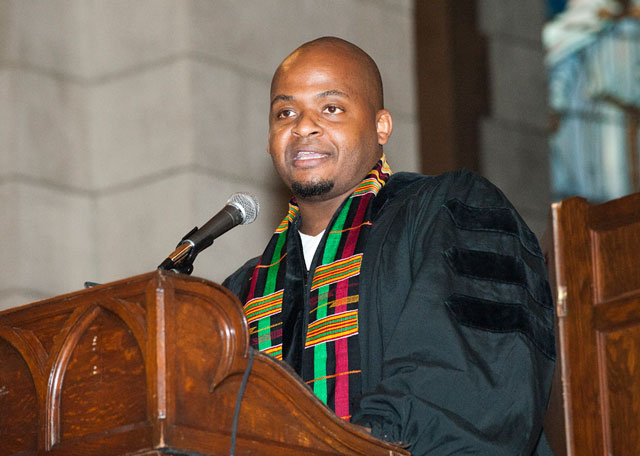
Student writers look to Laymon for wisdom
By Sarah Sgro '14
October 4, 2012
After its publication in July 2012, Kiese Laymon’s essay “How To Slowly Kill Yourself And Others in America: A Remembrance” received over 100,000 hits in just a few hours on the pop culture blog Gawker. Upon finding a version of the piece on Laymon’s personal blog Cold Drank, Gawker’s managing editor contacted him about republishing it as was, according to one of the site’s editors, it was “too good to pass up.”
Indeed, Laymon’s essay addressing the realities of growing up black in America is inspiring in its humble but impassioned reflections on the importance of remembering his own past as well as his larger racial history.
He writes powerfully in the essay, “I want to say and mean that remembering starts not with predictable punditry, or bullshit blogs, or slick art that really ask nothing of us; I want to say that it starts with all of us willing ourselves to remember, tell and accept those complicated, muffled truths of our lives and deaths and the lives and deaths of folks all around us over and over again.”
Born and raised in Jackson, Mississippi, Laymon employs his writing as a vehicle for coming to terms with his experiences as a black student on parole at Millsaps College and his realization that “parts of my state, much of my country, my heart and mostly my own reflection, had beaten the dog shit out of me.”
What is striking about his work, coinciding with its honesty and emotional fervor, is its sheer humanity: Laymon tells us what he knows about life and adversity, but he also tells us what he does not, and more than that, he tells us who he is not. He does not separate his own mistakes from the mistakes of others, and he relates them both to the complex social issues underlying self-hatred and the hatred of others in America.
Prior to his presentation on the Gawker essay in Wellin Hall, I was fortunate enough to speak with Laymon, a group of fellow creative writing students and Professor of Creative Writing Jane Springer about broader issues related to the writing process. What was intended to be a semi-structured coffee hour evolved into a comfortable, unpretentious discussion about the trials and rewards of both writing itself and the recognition that it can produce. Laymon talked openly about his struggle to process and transform much of his personal history into an emotionally intricate yet cohesive piece of nonfiction. After reading his essay several times and marveling at its depth of skill, it was a rare and enriching experience to hear him discuss the obstacles underlying its construction.
Equally if not even more captivating was Kiese’s discussion with Professor Springer about the complexities of success; both suggested difficult and perhaps unforeseen challenges in measuring the satisfaction of achievement with the unshakeable desire to pay back or return to their hometowns. For myself and, ostensibly, all other students present at the coffee hour, hearing two accomplished writers speak so candidly about such personal matters was unexpected and compelling.
Kiese is magnetic not only as a writer, but as a relatable person honest about his own process of creation and the trajectory of his success. As a creative writing major and aspiring writer myself, I readily absorbed his insight and feel privileged to have done so.