
Bicentennial Initiative funds need-blind and arts programs
by Allison Eck '12
MANAGING EDITOR
A total of $70 million has already been donated to Hamilton’s “Bicentennial Initiative,” a $117 million capital campaign underway to revamp the arts and support the College’s still young need-blind admission policy. The campaign was launched publicly on Friday, Dec. 3 at the College’s annual 1812 Leadership Circle Weekend in New York City.
Campaign Chair Jeff Little ’71, who also serves as the vice chair of the Board of Trustees, says that the campaign’s top priority is $40 million in new endowment to secure resources for the College’s fledgling need-blind admission policy. In addition, the campaign set a goal of $35 million for the construction of three new arts facilities, as well as $30 million unrestricted contributions to the Annual Fund. The left over $12 million is expected to go toward donor interests, given that they are in accordance with the College’s top concerns.
An estimated $2 million will need to be allocated to financial aid annually in order to ensure that Hamilton can meet the demonstrated need of its students. The College also seeks funding for three new arts facilities: a studio arts building, a theatre complex, and a teaching museum.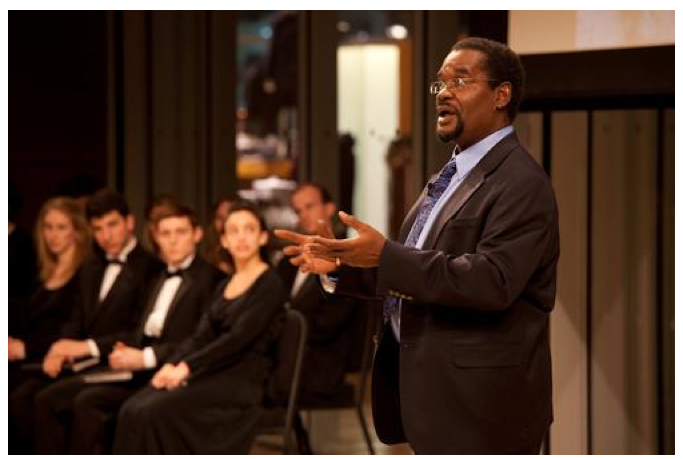
More than 375 alumni, parents and friends of the College attended the event in early December, during which President Joan Hinde Stewart read aloud passages from the speech that 1864 Hamilton graduate and U.S. statesman Elihu Root gave at the College’s centennial celebration. She also offered the oak tree metaphor that Hamilton’s fifth president Simeon North first put forth at his inaugural address in 1839, noting that the campaign reflects the College’s efforts to safeguard and shield – as do the arms of a tree – Hamilton’s legacy and posterity.
Stewart was quoted in an article on Hamilton’s website as stating that “one hundred years from now, those who take our place will look back and recognize the surge of creativity we made possible with stunningly beautiful and functional arts facilities; they will look back with gratitude for the scholarships we provided so that they could attend a college of such distinction; and they will feel the same sense of belonging to ‘thy homestead glade and glen,’” a reference to the college’s alma mater Carissima.
At the celebration, Associate Professor of Theatre Mark Cryer presented a multimedia production based loosely on the College’s history, which will be published in a much-anticipated new book by James L. Ferguson Professor of History Maurice Isserman. Performances by the College Hill Singers, senior Ileana Becerra and junior Kadahj Bennett, videos produced by independent film producer and 1999 Hamilton graduate David Gaynes accompanied the presentation.
“We are taking this step now to make a bold statement about what we value as a college and to position Hamilton for the long term,” Chairman of the Board of Trustees A.G. Lafley said in the website article on the Initiatives. “Protecting our legacy as a school of opportunity is our highest priority.” Part of that bold statement is an allegiance to the importance of arts education, especially in an age when many secondary schools and universities across the country are cutting funding for humanities and the arts.
Alumni and friends of the College can participate in the Bicentennial Initiatives through the Annual Fund. Support for the Annual Fund will help keep the need-blind initiative afloat until new endowments are established. Little mentioned at the launch that he and the rest of the campaign hope that those associated with the College will seize the opportunity to give through the Annual Fund and thereby serve future generations of Hamilton students.